 Click to view the Temperature graph
Temperature trends inform us of the state of bearings, associated friction, and sometimes the loading of machinery. The canary has an internal temperature sensor which tells us the ambient (or surrounding) temperature. By comparing the machine temperature with the ambient temperature, you can tell whether that piece of machinery is running unusually hot or not.
Many pieces of machinery are driven by motors that have cooling fans attached to them. When the motor is switched off, the fan stops, and the surface of the motor and nearby machinery actually heats up as the internal heat of the motor comes out – this is known as “heat soak”. Very often, the NDE sensor on a motor is mounted in the air stream from the motor's cooling fan, and therefore reflects a temperature much lower than the DE sensor. In cases where this happens, it is noticeable that when the motor is turned off, the NDE temperature shoots up to the same level as the DE temperature. An example of this can be seen in the graph below, towards the right hand side. The motor was switched off at about the vertical cursor (12:00 AM on 19 June), and the heat soak on DE and AUX1 can be seen, as well as the major rise of NDE towards DE.
Click to view the Temperature graph
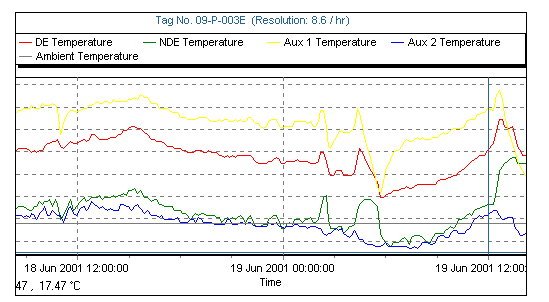
We have seen this occasionally in machines that stand outside... in the rain. If you suspect rain, try correlating it with a different machine that is outdoors on the same site to see if the temperature dips at the same time.
We can only make sense of the temperature of a machine if we know how high it is with respect to the ambient (surrounding) temperature. For example, a bearing that is at a temperature of 60 degrees Celsius is probably OK if the ambient temperature is 45 deg. C., but it is not OK if the ambient temperature is 5 deg. C. In the first case the bearing is only 15 degrees above the surrounding temperature, but in the second case it is 55 degrees higher in temperature, and is probably starting to deteriorate.
Temperature normalization refers to the practice of adjusting the measured temperature of a motor according to the load on the motor. An unloaded motor should run much cooler than a fully loaded motor. We would usually define a normalized temperature parameter TH, which is calculated as TH = (measured temperature - ambient temperature) x 100 / load, where the load is expressed as a percentage. Motornostix software cannot directly graph the normalized temperature TH, as we do not usually have access to sensors that can measure the real load. We are currently working on ways to infer the load from other data. This must be done with care, as it can be seen by looking at the above equation that when the motor is switched off (but has not yet cooled down), the normalized temperature will be infinity.